
Nationwide small business loan providers give business owners access to capital without being limited by a local bank’s lending territory or risk appetite. Today, companies across the United States search for nationwide small business loan providers when they need fast funding, flexible terms, or financing their community bank simply cannot offer. For example, a retailer in rural Montana may qualify for the same $500,000 working capital loan as a shop owner in Miami, provided both meet the lender’s underwriting standards. In this guide, you will learn how nationwide lenders work, what financing types they offer, and how to choose a lending partner suited to your business goals.

Comparing offers from nationwide small business loan providers helps owners find the right fit for their revenue and timeline.
What Are Nationwide Small Business Loan Providers?
Nationwide small business loan providers are lenders, banks, and alternative financing companies that fund businesses in all 50 states rather than one metro area. These lenders typically offer SBA loans, term loans, lines of credit, and similar products ranging from $30,000 to $20 million, underwritten primarily on business performance instead of geography.
Unlike a community bank that may only serve a handful of zip codes, a nationwide lender builds standardized underwriting criteria that apply equally across regions. Consequently, a business in a small town often has the same access to working capital as one in a major city. In addition, many nationwide lenders operate largely online, which speeds up document review and approval decisions. However, this does not mean every lender is identical; terms, rates, and speed still vary significantly between providers.
Why Work With Nationwide Business Lenders Instead of Local Banks?
Local banks can be excellent partners, but they often have narrower lending criteria and slower decision-making processes. In contrast, nationwide business lenders frequently use automated income verification and digital underwriting, which shortens approval timelines considerably. For businesses that need emergency funding or a short-term bridge loan, this speed can matter more than a slightly lower interest rate.
Furthermore, nationwide lenders tend to offer a broader product mix. A single provider might offer SBA loans, equipment financing, invoice financing, and merchant cash advances under one roof, whereas a local bank may only offer conventional term loans. As a result, business owners can often meet multiple financing needs without juggling several relationships. Similarly, because nationwide lenders serve a larger, more diverse pool of borrowers, they can sometimes extend credit to businesses that a single-region bank would consider too niche or unfamiliar.
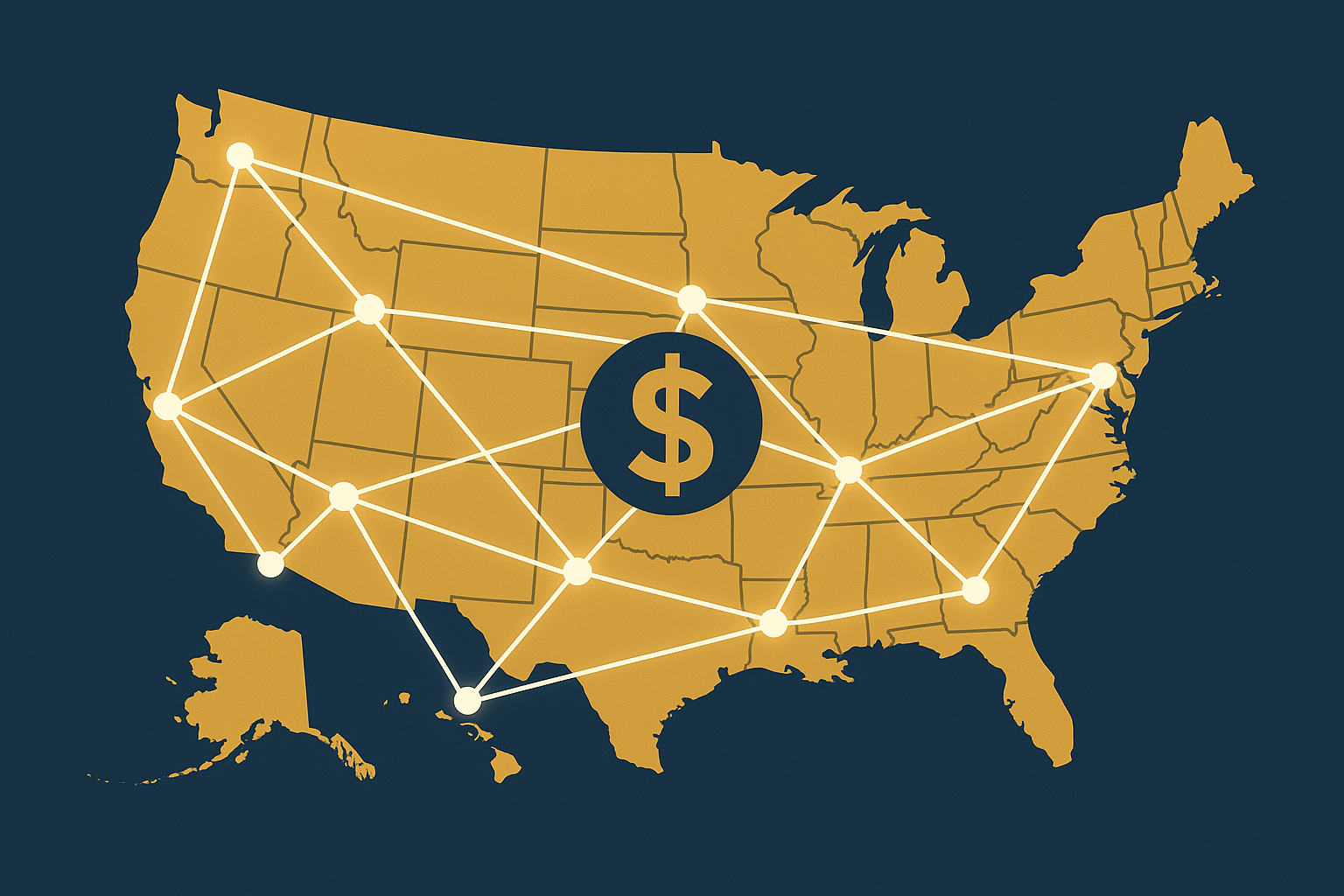
A nationwide lending network allows businesses in any state to access similar financing products.
Types of Financing Offered by Small Business Loan Providers Nationwide
Small business loan providers nationwide generally offer several categories of financing, each suited to different needs:
- SBA loans — government-backed loans with longer terms and competitive rates.
- Working capital loans — short-term funding for day-to-day operating expenses.
- Business lines of credit — flexible, revolving access to funds as needed.
- Term loans — a lump sum repaid over a fixed schedule.
- Equipment financing — funding tied directly to purchasing machinery or tools.
- Merchant cash advances and revenue-based financing — repayment tied to future sales.
- Invoice financing — advances against unpaid customer invoices.
- Same-day and emergency business funding — rapid-access capital for urgent needs.
Specifically, businesses expanding into a new location may lean toward term loans or expansion financing, while a seasonal retailer might prefer a line of credit. For a deeper comparison of expansion-focused options, this guide to nationwide business expansion loans breaks down funding speed and typical terms.
How to Choose the Right Small Business Lending Partner
Choosing among nationwide small business loan providers requires more than comparing headline interest rates. Above all, business owners should evaluate total repayment cost, required documentation, and how quickly funds actually arrive. A lender advertising a low rate but requiring six weeks of underwriting may not suit a business facing an urgent cash flow gap.
Therefore, it helps to start by defining the loan’s purpose. For instance, equipment purchases often pair well with equipment financing, while unpredictable revenue may call for revenue-based financing instead of a fixed term loan. In particular, businesses should also confirm minimum revenue requirements; most nationwide lenders expect at least $20,000 in monthly revenue before approving financing. Reviewing resources such as this nationwide lender comparison guide can simplify the research process considerably.
Step-by-Step: How to Apply With a Nationwide Lender
Once a business has selected a financing type, the application process generally follows a consistent sequence:
- Review business financials. Gather recent bank statements, tax returns, and a profit and loss statement so the lender can accurately assess monthly revenue and cash flow.
- Identify the right loan product. Decide whether a term loan, line of credit, SBA loan, or short-term funding product matches the timeline and purpose of the capital needed.
- Submit a complete application. Provide accurate business information, ownership details, and supporting documents in one submission to avoid delays during underwriting review.
- Respond to underwriting requests promptly. Answer any follow-up questions from the lender quickly, since missing documentation is one of the most common reasons approvals slow down.
- Review and accept funding terms. Carefully read the repayment schedule, total cost, and any fees before signing, then receive funds by direct deposit once approved.
For businesses pursuing the quickest possible timeline, this resource on the fastest business loans available nationwide outlines products designed specifically for urgent funding needs.
Factors That Affect Approval and Funding Speed
Several factors influence both whether a business is approved and how fast funds arrive. Credit score, time in business, monthly revenue, and existing debt obligations all play a role in underwriting decisions. Consequently, businesses with consistent deposits and manageable debt loads tend to receive faster, more favorable offers.
According to the Federal Reserve’s Small Business Credit Survey, roughly two-thirds of small employer firms applied for external financing within the prior year, and many turned to online or nationwide lenders after facing delays with traditional banks. This data point underscores why speed and clear qualification criteria matter so much when selecting a lender. In addition, the U.S. Small Business Administration notes that SBA 7(a) loans remain one of the most widely used government-backed financing programs nationwide, though they typically involve longer processing timelines than private working capital products. For businesses prioritizing approval odds, this guide to lenders with strong approval rates is a useful next step.

Clear terms and a transparent process build trust between borrowers and nationwide lenders.
USA Patriot Loans: A Nationwide Financing Option
USA Patriot Loans, founded in November 2023 and headquartered in Pennsylvania, is a disabled-veteran-owned company that serves businesses in all 50 states. Specifically, the company offers SBA loans, working capital loans, business lines of credit, short-term loans, term loans, equipment financing, merchant cash advances, revenue-based financing, invoice financing, and same-day business funding for companies generating at least $20,000 in monthly revenue.
Rather than relying on rigid, one-size-fits-all underwriting, USA Patriot Loans works to match business owners with financing suited to their specific revenue pattern and timeline. Readers researching options with minimal paperwork may also find this guide to fast-approval loans with minimal paperwork useful before applying. To learn more about available programs, visit USA Patriot Loans directly.
Frequently Asked Questions About Nationwide Small Business Loan Providers
What are nationwide small business loan providers?
Nationwide small business loan providers are lenders, banks, and alternative financing companies that fund businesses in all 50 states rather than a single region. They typically offer SBA loans, term loans, lines of credit, and other products based on business performance instead of location.
How do nationwide lenders differ from local community banks?
Nationwide lenders use standardized underwriting models that let them serve businesses anywhere in the country, while local banks often limit lending to their service footprint. As a result, nationwide lenders can typically offer faster decisions and a wider range of loan products.
How much can a small business borrow from a nationwide lender?
Loan amounts from nationwide small business loan providers generally range from $30,000 to $20 million, depending on the lender, loan type, and the business’s revenue and credit profile. Larger amounts usually require stronger financials and collateral.
How fast can a business get funded by a nationwide lender?
Many nationwide lenders can approve and fund short-term loans or working capital advances within 24 to 72 hours. SBA loans and larger term loans typically take longer, often two to eight weeks, due to additional documentation requirements.
What documents do nationwide small business loan providers require?
Most lenders ask for recent bank statements, tax returns, a profit and loss statement, and proof of business ownership. SBA and larger term loans may also require a business plan and collateral documentation.
Is it better to choose an SBA loan or a working capital loan?
SBA loans typically offer lower interest rates and longer terms but involve slower approval timelines. Working capital loans fund faster and suit urgent, short-term needs, so the better choice depends on how quickly the business needs capital.
What credit score is needed to qualify for a nationwide business loan?
Requirements vary widely, but many nationwide lenders accept personal credit scores in the mid-600s for working capital products, while SBA loans and traditional term loans often prefer scores of 680 or higher.
What is the most common mistake businesses make when applying?
A common mistake is applying with incomplete or inconsistent financial documents, which slows underwriting and can trigger a denial. Preparing accurate bank statements and tax returns in advance helps avoid delays.
How much does it cost to borrow from a nationwide lender?
Costs vary by product: SBA and term loans often carry annual interest rates between 7% and 15%, while short-term products and merchant cash advances can carry higher factor-rate-based costs. Always compare the total repayment amount, not just the rate.
Can a startup qualify with nationwide small business loan providers?
Most nationwide lenders prefer established businesses generating at least $20,000 in monthly revenue, so brand-new startups may have limited options. Businesses with at least six months to a year of operating history typically qualify more easily.
What is the best way to compare nationwide business lenders?
Compare total repayment cost, funding speed, required documentation, and whether the lender offers the specific product your business needs, such as a line of credit or equipment financing. Reading lender-specific terms carefully helps avoid surprises later.
Final Thoughts
Choosing among nationwide small business loan providers ultimately comes down to matching the right product, speed, and cost structure to your business’s specific situation. Whether you need same-day emergency funding, an SBA loan for long-term growth, or a flexible line of credit, understanding how nationwide lenders operate puts you in a stronger position to negotiate favorable terms. In summary, compare total cost rather than rate alone, confirm revenue and credit requirements upfront, and prepare documentation before applying. By following the steps outlined above and consulting trusted nationwide small business loan providers like USA Patriot Loans, business owners nationwide can secure the capital they need with far less friction than traditional financing often requires.
Leave a Reply