
Revenue based financing options give small business owners a way to access capital by repaying a lender with a fixed percentage of future sales instead of a fixed monthly payment. For many founders, this approach feels less rigid than a traditional bank loan, especially when cash flow varies from month to month. In this guide, we’ll break down how revenue-based funding works, who it fits best, and how it compares to other tools like bank loans with fixed interest rates. We’ll also walk through the qualification steps so you can decide whether this financing path suits your business today.
Quick Answer: Revenue based financing options let a business trade a percentage of future monthly revenue for upfront capital, with no fixed payment amount and repayment that flexes alongside sales.
What Is Revenue Based Financing?
Revenue based financing options are funding tools that provide a lump sum of capital in exchange for a fixed percentage of a business’s future monthly revenue, continuing until the total repayment amount is satisfied. Unlike a conventional term loan, there is no set monthly installment. Instead, payments rise during strong sales months and shrink during slower ones.
This structure is why many owners describe it as a flexible alternative to a fixed-payment loan. Because the lender’s repayment is tied directly to revenue performance, the underwriting process leans heavily on bank statements and sales history rather than personal credit alone. As a result, businesses with strong cash flow but limited collateral often qualify more easily than they would through a bank. You can read more about this structure in the Wikipedia overview of revenue-based financing.

Reviewing monthly revenue is the first step to comparing revenue based financing options.
How Does Revenue-Based Funding Work?
In practice, a lender first calculates an advance amount based on your average monthly revenue over the past three to twelve months. Then, instead of charging traditional interest, the lender applies a factor rate — a multiplier such as 1.2 or 1.4 — to determine the total amount owed. For example, a $50,000 advance at a 1.3 factor rate means $65,000 must eventually be repaid.
Repayment usually happens through automatic daily or weekly deductions from a business bank account or merchant processing account. Because the deduction is a percentage of revenue rather than a flat dollar figure, payments naturally adjust as sales fluctuate. Consequently, a slow month results in a smaller deduction, while a strong month speeds up repayment.
Steps to Qualify for Revenue Based Financing Options
- Review your monthly revenue. Pull three to six months of bank statements and calculate your average monthly revenue, since this figure largely determines how much funding you can qualify for.
- Gather financial documentation. Collect bank statements, proof of business ownership, and recent tax returns so a lender can quickly verify revenue and history during underwriting.
- Compare revenue based financing options. Request quotes from more than one lender and compare the factor rate, total repayment, and the deduction percentage before choosing an offer.
- Submit your application. Complete the application with supporting documents and respond quickly to underwriting questions to keep the process moving.
- Receive funds and begin repayment. Once approved, funds typically arrive within one to three business days, and repayment starts automatically as a percentage of incoming revenue.
Revenue Based Financing Options vs. Traditional Business Loans
Traditional term loans and SBA loans generally offer lower overall costs, but they also require stronger credit, collateral, and longer approval timelines. In contrast, revenue based financing options prioritize speed and revenue consistency over credit history. This makes them appealing for businesses that need capital quickly or don’t yet qualify for bank-grade underwriting.
However, this convenience typically comes at a higher cost. Therefore, it’s worth comparing the true cost of revenue-based funding against options such as a term loan with a fixed bank interest rate before committing. You can also review the U.S. Small Business Administration’s loan programs as a benchmark, since SBA-backed lenders approved more than $27 billion in 7(a) loans during fiscal year 2023, according to SBA figures.
Types of Revenue Based Financing Options for Small Businesses
Not every revenue-based product looks the same. In particular, businesses should understand a few common structures before comparing offers:
- Merchant cash advances — repaid through a percentage of daily card sales, best suited to retail or restaurant businesses.
- Bank-revenue advances — repaid through a percentage of total bank deposits, useful for service businesses with fewer card transactions.
- Hybrid working capital loans — blend a fixed term with revenue-linked adjustments during slow seasons.
Above all, the right structure depends on how your business collects revenue day to day. A business with heavy card sales may lean toward a merchant advance, while a service company billing clients by invoice might instead consider quick funding options built for payroll and equipment needs.
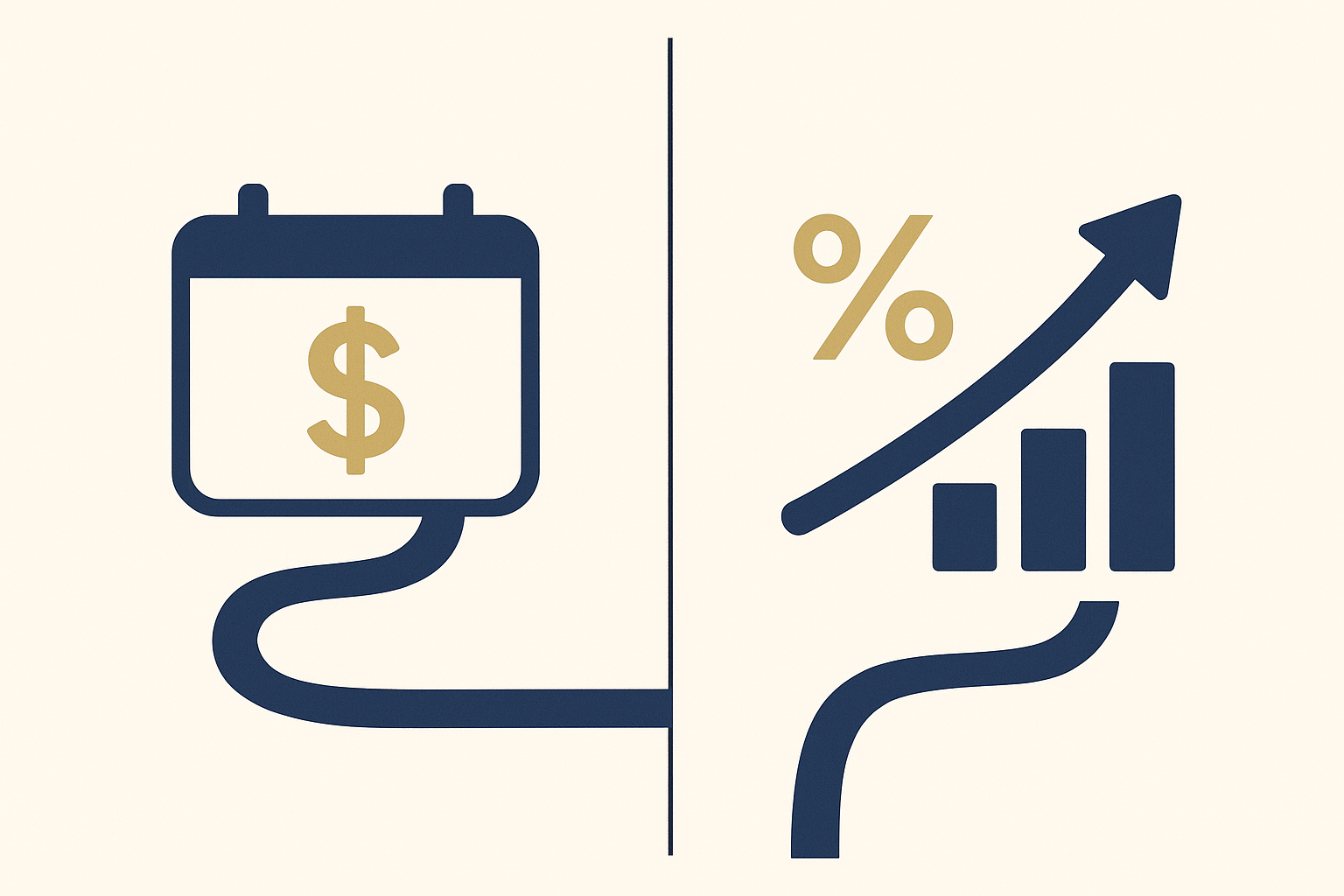
Comparing fixed loan payments against flexible revenue-based repayment helps clarify which financing fits best.
Who Benefits Most From Revenue-Based Business Funding?
Seasonal businesses, retailers, and service companies with variable monthly income tend to benefit the most, since payments scale with sales rather than staying fixed. Similarly, businesses that need capital quickly for inventory, payroll, or an unexpected expense often turn to revenue-based funding because approval can happen in days rather than weeks.
On the other hand, businesses with strong credit and steady, predictable revenue may find better long-term value in a traditional term loan or a financing option designed specifically for equipment purchases. As always, the right fit depends on your specific revenue pattern and how urgently you need the funds. USA Patriot Loans, a disabled-veteran-owned lender founded in 2023, works with businesses nationwide generating at least $20,000 in monthly revenue to match owners with the financing structure that fits their cash flow.
Costs, Factor Rates, and Repayment Terms
Instead of an annual percentage rate, revenue-based funding typically uses a factor rate between roughly 1.1 and 1.5. For example, a $100,000 advance at a 1.3 factor rate requires $130,000 in total repayment, regardless of how long it takes. As a result, paying it off faster generally lowers the effective annualized cost, while a slow repayment period raises it.
Because of this structure, it’s important to calculate the daily or weekly deduction amount before signing any agreement. In addition, always ask whether early payoff offers any discount, since not every lender provides one. For a deeper look at whether this cost structure makes sense for your situation, see this breakdown of whether revenue-based financing is a good option for your business.
How to Choose the Right Revenue Based Financing Options
First, calculate your true monthly cash flow after existing debt obligations, since this determines how much of a revenue deduction your business can comfortably absorb. Next, request itemized quotes from several lenders and compare the factor rate, total repayment figure, and deduction percentage side by side rather than focusing on the advance amount alone.
Finally, consider pairing your search with related financing research, such as this guide to fast-approval small business loans with minimal paperwork. Businesses headquartered anywhere in the United States can also explore nationwide funding programs directly through USA Patriot Loans, which offers funding from $30,000 up to $20 million across working capital, equipment, and revenue-based products.

Comparing offers carefully helps ensure the chosen revenue based financing options match your cash flow.
Frequently Asked Questions About Revenue Based Financing Options
What are revenue based financing options?
Revenue based financing options are funding arrangements where a business receives a lump sum of capital and repays it through a fixed percentage of monthly revenue until the agreed total is paid off. Payments rise and fall with sales, so there is no fixed installment like a traditional loan.
How does revenue based financing work?
A lender advances capital based on your historical revenue, then collects a set percentage of future sales through daily or weekly deductions. The total repayment amount is calculated using a factor rate rather than a traditional interest rate.
Why do small businesses choose revenue-based funding?
Businesses with seasonal or fluctuating income often prefer revenue-based funding because payments scale down during slower months. It also tends to have faster approval timelines and fewer collateral requirements than bank loans.
How is revenue-based financing different from a business line of credit?
A business line of credit lets you draw funds as needed and pay interest only on what you use, while revenue-based financing provides a lump sum repaid as a percentage of sales. Lines of credit are typically revolving, whereas revenue-based deals are usually one-time advances.
What does revenue based financing cost?
Costs are expressed as a factor rate, commonly between 1.1 and 1.5 times the amount borrowed, rather than an annual percentage rate. The effective cost depends heavily on how quickly the business repays the advance.
How fast can I get approved for revenue based financing options?
Many lenders can approve and fund revenue-based financing within 24 to 72 hours because underwriting relies primarily on bank statements and revenue history. Same-day funding is sometimes available for qualified applicants.
What documents do I need to qualify?
Most lenders request three to six months of business bank statements, proof of monthly revenue, and basic business identification documents. Tax returns and financial statements may be requested for larger funding amounts.
What is a factor rate in revenue-based financing?
A factor rate is a multiplier applied to the amount borrowed to determine total repayment, expressed as a decimal such as 1.2 or 1.4. Unlike an interest rate, it does not change based on repayment timing, though the effective annualized cost does.
What common mistakes do business owners make with revenue-based funding?
A frequent mistake is stacking multiple advances at once, which can strain daily cash flow across several repayment obligations. Another is failing to compare the total repayment cost across offers before signing.
Is revenue-based financing better than a merchant cash advance?
Revenue-based financing and merchant cash advances are structurally similar, but revenue-based deals often use total bank revenue rather than card sales alone. The better choice depends on how your business collects revenue day to day.
What credit score is required for revenue based financing options?
Credit score requirements are generally lower than bank loans, with many lenders approving applicants with scores in the mid-500s or higher. Revenue consistency typically matters more than credit history in underwriting decisions.
Can startups qualify for revenue-based funding?
Startups with little or no revenue history usually do not qualify, since lenders base offers on consistent monthly revenue. Most programs require at least six months to a year of operating history and a minimum monthly revenue threshold.
What are the best practices before signing a revenue-based financing agreement?
Always calculate the total repayment amount and the effective daily or weekly deduction before signing, and confirm there are no early payoff penalties. It also helps to compare at least two or three offers side by side.
How much funding can my business get through revenue based financing options?
Funding amounts typically range from a few thousand dollars up to several million, depending on monthly revenue and time in business. Lenders generally offer advances equal to a percentage of average monthly revenue.
Final Thoughts
Ultimately, revenue based financing options work best for businesses that need fast capital and prefer repayment that flexes with sales rather than staying fixed. Still, it’s worth weighing the total cost against alternatives like SBA loans, term loans, or a business line of credit before signing an agreement. By comparing factor rates, repayment percentages, and funding timelines across a few lenders, you can choose the structure that genuinely fits your cash flow. For businesses ready to move forward, resources like USA Patriot Loans and the SBA’s loan program directory are reasonable starting points for further research.