
An SBA loan payment is the fixed or variable monthly amount a borrower pays toward principal and interest on financing backed by the U.S. Small Business Administration. For business owners comparing financing options, understanding exactly how that payment is calculated matters just as much as securing approval in the first place. Below, we break down the factors that shape your monthly cost, walk through a step-by-step estimation process, and explain how to keep payments manageable as your business grows.
Quick answer: An SBA loan payment is calculated by amortizing your loan amount, interest rate, and term length into equal monthly installments. A $500,000 SBA 7(a) loan at 10 percent over 10 years, for example, results in a payment near $6,608 per month.
What Is an SBA Loan Payment?
An SBA loan payment is simply the recurring installment you owe each month on a loan partially guaranteed by the Small Business Administration. Unlike a private business loan, an SBA loan spreads risk between the lender and the government agency, which often results in lower rates and longer repayment terms. Consequently, monthly payments tend to be more predictable than short-term financing products.
Most SBA loans, including the popular SBA 7(a) loan program, use standard amortization. This means each payment covers a portion of interest and a portion of principal, with the interest share shrinking over time as the balance decreases.

Reviewing an amortization table is the fastest way to understand your projected SBA loan payment.
How SBA Loan Payments Are Calculated
SBA loan payments follow a standard amortization formula. In simple terms, amortization is the process of paying off debt through scheduled, equal payments over time. The formula factors in three core inputs: the loan principal, the annual interest rate, and the total number of payments.
As a result, two loans of the same size can carry very different monthly payments depending on rate and term. For instance, extending a term from 7 to 10 years lowers the monthly obligation but increases the total interest paid across the life of the loan. Therefore, it is worth comparing multiple term options before committing to a lender.
Key Factors That Affect Your SBA Loan Payment
Several variables directly influence your SBA loan payment amount. Understanding each one helps you negotiate better terms and avoid surprises later.
- Loan amount: Larger loans naturally produce higher monthly payments, all else being equal.
- Interest rate: SBA rates are typically tied to the prime rate plus a lender markup, so rate changes ripple directly into your payment.
- Repayment term: Longer terms reduce monthly cost but raise total interest paid over time.
- Fees financed into the loan: Guarantee fees and closing costs rolled into the balance slightly increase your payment.
- Fixed versus variable structure: Variable-rate loans can shift payments up or down as benchmark rates change quarterly.
SBA Loan Repayment Terms Explained
SBA loan repayment terms vary based on how the funds are used. Working capital and equipment loans typically max out around 10 years, while real estate purchases can extend to 25 years under the SBA 504 program. In contrast, short-term financing products outside the SBA umbrella often require repayment within 12 to 24 months, which naturally produces a much higher monthly payment.
Similarly, the SBA 504 loan structure splits financing between a bank-funded first mortgage and a below-market Certified Development Company portion. This blended structure often results in a lower combined SBA loan payment for real estate and heavy equipment purchases compared to a single conventional loan.
Step-by-Step: Estimating Your Monthly SBA Loan Payment
Before applying, it helps to estimate your likely payment so you can budget accordingly. Follow these steps to get a reasonably accurate projection.
- Determine your loan amount. Decide exactly how much capital your business needs based on the specific use of funds, such as equipment, expansion, or working capital.
- Identify the applicable interest rate. Check the current SBA maximum allowable rate for your loan program, generally tied to the prime rate plus a lender markup.
- Choose your repayment term. Select a term based on what the funds finance, since working capital, equipment, and real estate carry different SBA term limits.
- Calculate the amortized payment. Use an online calculator or the standard amortization formula to convert loan amount, rate, and term into a monthly figure.
- Add applicable fees. Factor in the SBA guarantee fee and any closing costs financed into the loan, since these slightly raise your total monthly payment.
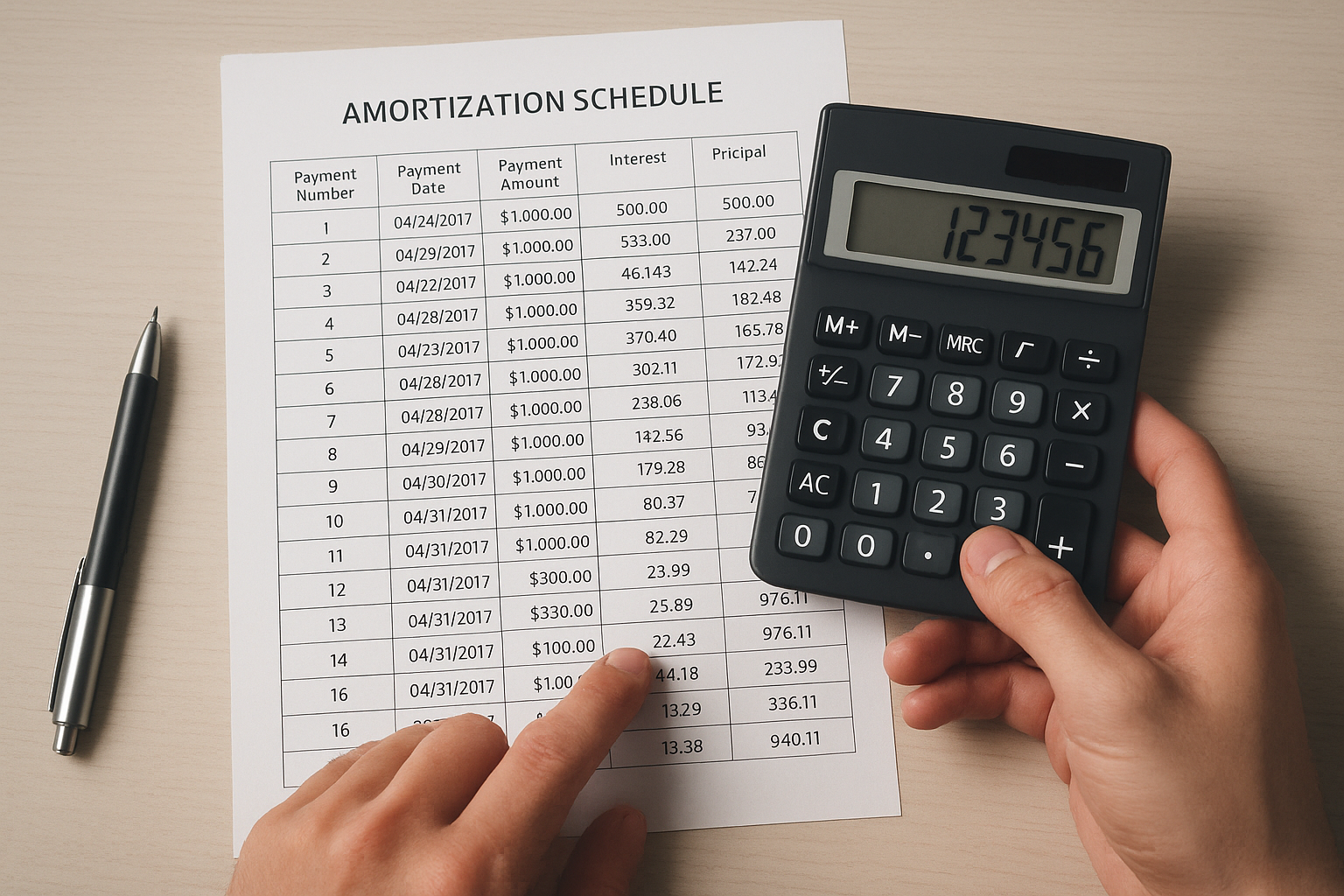
A simple calculator can help estimate your SBA loan payment before you formally apply.
Common Mistakes That Increase Your SBA Loan Payment
Many borrowers unintentionally increase their monthly obligation through avoidable missteps. For example, choosing a shorter term than necessary can strain monthly cash flow, even though it saves on total interest. In addition, borrowers with weaker credit sometimes accept the first rate offered without shopping around, missing out on better pricing elsewhere.
Another frequent error is underestimating fees. Guarantee fees on larger SBA 7(a) loans can reach several percentage points of the guaranteed portion, and financing that fee into the loan raises the payment slightly every month. Above all, borrowers should request a full amortization schedule before signing, since it reveals the true total cost rather than just the advertised rate.
How USA Patriot Loans Helps With Business Financing
Not every business qualifies for a traditional SBA loan, and the approval process can take weeks or months. USA Patriot Loans, a disabled-veteran-owned nationwide lender founded in 2023, works with established businesses generating at least $20,000 in monthly revenue to arrange working capital loans, term loans, equipment financing, and business lines of credit ranging from $30,000 to $20 million.
For businesses that need funding faster than a traditional SBA timeline allows, options like same-day business funding or short-term business loans can bridge the gap while a longer-term SBA application is in process. To see how the company’s approach differs from conventional bank lending, visit the why choose us page for more detail on eligibility and turnaround times.
According to SBA.gov, 7(a) loans remain the agency’s most common financing vehicle, and rates are published quarterly based on prime plus a set spread. Comparing that published rate against alternative lenders, as explained further on USA Patriot Loans’ website, helps business owners decide which financing path fits their timeline and budget.
SBA Loan Payment vs. Alternative Financing Payments
Compared to a merchant cash advance or revenue-based financing, an SBA loan payment is fixed and predictable rather than tied to daily sales volume. According to Investopedia, SBA-backed loans typically carry lower overall borrowing costs than most alternative products, though they require stronger credit and more documentation to qualify. Consequently, businesses with urgent capital needs sometimes use short-term financing first and refinance into an SBA loan once cash flow stabilizes.
Frequently Asked Questions About SBA Loan Payment
What is an SBA loan payment?
An SBA loan payment is the recurring monthly amount a borrower pays toward principal and interest on a loan guaranteed by the U.S. Small Business Administration. Payments are typically structured through full amortization over the loan term.
How is an SBA loan payment calculated?
An SBA loan payment is calculated using an amortization formula that factors in the loan amount, interest rate, and repayment term. Lenders spread principal and interest across equal monthly installments so the balance reaches zero by the end of the term.
What is the average SBA loan payment for a $500,000 loan?
At a 10 percent rate over a 10-year term, a $500,000 SBA loan payment runs roughly $6,608 per month. The exact figure shifts based on the current interest rate, term length, and any fees rolled into the loan.
Are SBA loan payments fixed or variable?
SBA loan payments can be either fixed or variable, depending on the loan program and lender agreement. Variable-rate loans adjust periodically with a base index such as the prime rate.
How long are SBA loan repayment terms?
SBA loan repayment terms typically range from 10 years for working capital and equipment to 25 years for real estate purchases. Longer terms lower the monthly payment but increase total interest paid.
Can I pay off my SBA loan early?
Yes, most SBA loans allow early payoff, though loans with terms of 15 years or longer may carry a prepayment penalty during the first three years. Shorter-term SBA loans generally have no prepayment penalty.
What happens if I miss an SBA loan payment?
Missing an SBA loan payment typically triggers a late fee and a negative mark on your credit report after the grace period ends. Continued missed payments can lead to default or collateral seizure.
Do SBA loans require a down payment?
Many SBA loans, particularly those used for business acquisitions or real estate, require a down payment of 10 to 20 percent. Working capital and equipment-focused SBA loans sometimes require little to no down payment.
How does the SBA loan payment differ between SBA 7(a) and SBA 504 loans?
An SBA 7(a) loan payment usually carries a single variable or fixed rate across the full balance, while an SBA 504 loan payment splits between a bank portion and a below-market Certified Development Company portion. This often makes SBA 504 payments lower for real estate purchases.
What credit score do I need to qualify for a manageable SBA loan payment?
Most lenders look for a personal credit score of 650 or higher to offer competitive rates that keep your SBA loan payment manageable. Scores above 700 usually unlock better terms.
How does interest rate affect my SBA loan payment amount?
Even a one percentage point increase in interest rate can raise a $250,000 SBA loan payment by roughly $130 to $150 per month over a 10-year term. Because SBA rates track the prime rate, payments can shift with Federal Reserve rate changes.
What documents are needed to apply for an SBA loan?
Lenders generally request business and personal tax returns, financial statements, a business plan, and debt schedules. Additional documents like bank statements help speed up underwriting.
How quickly can I get approved for an SBA loan?
Traditional SBA 7(a) approval can take 30 to 90 days depending on the lender and loan complexity. Some SBA Express loans or alternative financing options move much faster.
Are there fees added to my SBA loan payment?
SBA loans include a guarantee fee, which can sometimes be financed into the loan and spread across monthly payments. Closing costs and servicing fees may also factor into the total repayment amount. For a deeper walkthrough, see our What Are the Costs Associated With SBA Loans?.
What’s the difference between an SBA loan payment and a merchant cash advance payment?
An SBA loan payment is a fixed monthly installment based on amortization, while a merchant cash advance payment fluctuates daily or weekly based on a percentage of sales. SBA loans generally offer lower overall costs but require stronger credit.

Understanding your SBA loan payment upfront helps both borrowers and lenders finalize terms with confidence. For a deeper walkthrough, see our SBA Small Business Loan Guide: Rates, Terms & How to Qualify.
Final Thoughts on Your SBA Loan Payment
In summary, your SBA loan payment depends on three connected variables: loan amount, interest rate, and repayment term. Because these factors interact, even small changes in rate or term length can meaningfully shift your monthly obligation. As a result, running the numbers before applying, comparing lenders, and requesting a full amortization schedule are essential steps toward avoiding surprises down the road.
Whether you pursue a traditional SBA 7(a) loan or explore alternative financing while your SBA application is pending, understanding how an SBA loan payment is structured puts you in a stronger negotiating position. For businesses that need capital sooner than a traditional SBA timeline allows, working with a lender that offers flexible products alongside SBA guidance can make the entire process smoother from application to funding.